
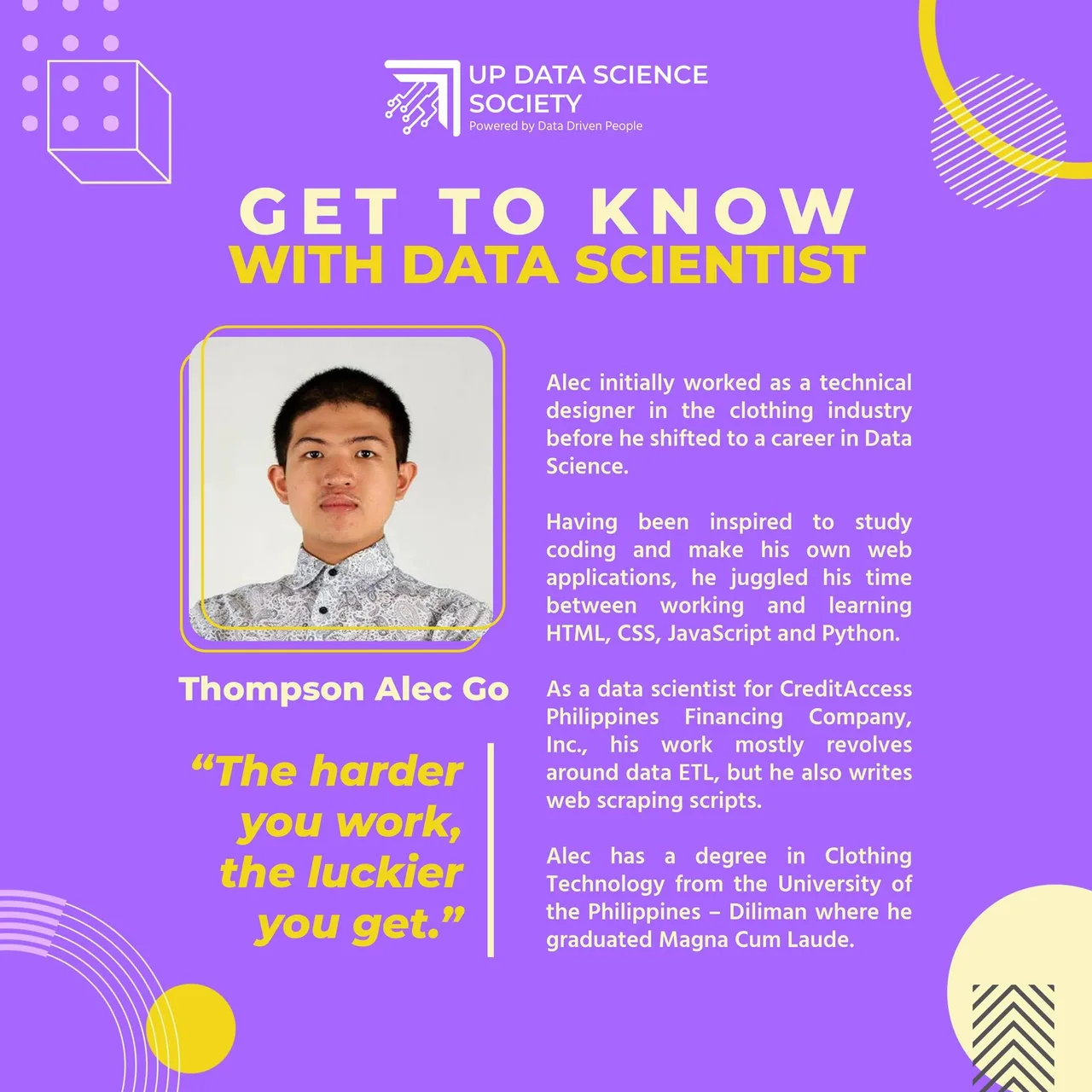
Thompson Alec Go did not plan to become a data scientist. He graduated magna cum laude in Clothing Technology from the University of the Philippines Diliman and worked for two years as a technical designer in the garment industry. By the end of his first year he knew he would leave. He had started recommending tools like Airtable and Trello to digitize the company’s work, and recommending apps made him want to build them. So he studied HTML, CSS, JavaScript, and Python after work.
It took about nine months of evening study before he started applying for developer and data science roles, and by his own account he was not a good programmer when he was hired. He became one on the job, by using it every day. At the time of this interview he was a data scientist at CreditAccess Philippines Financing Company, Inc.
What the work looks like
Alec describes the job more plainly than most listings do. People assume data scientists build machine learning models all day. Some roles need that, but most of the demand is in ETL and quality control: transforming data so that other people can use it. His own work is mostly automating cleaning and transformation, plus web scraping scripts. He has automated data entry with robotic process automation and solved a linear programming problem with PuLP. A typical day, in his summary, is writing Python.
Coming from a non-technical degree, he felt small next to teammates with mathematics and physics backgrounds. What changed that was seeing other people use the things he built.
Advice for students
For students hoping to be hired without an engineering background:
- Learn Excel. Most companies still run on it, and it is often enough.
- Learn Python, and use it, not just study it.
- Learn to ask the right questions. He googles things constantly at work and has no shame about it. Someone has usually hit the same problem before.
- Learn the industry you are in and what the business needs.
He prefers free or cheap resources: Python for Everybody, Python Like You Mean It, freeCodeCamp on YouTube, and Udemy. On a master’s degree, he thinks money spent on learning is always well spent and a degree from a reputable program opens doors, but it is not the only path. A degree may get you the interview; you still have to pass it.
Projects, ethics, interviews
He starts every project by investigating the data: how it was collected, what type each column is, where the gaps are, and what it could answer. If he cannot answer those himself, he asks the people who collected it.
On ethics, his concerns are consent from the people whose data is collected, their privacy, and whether the collectors can be trusted, since human error in pen-and-paper collection is still real.
Interviews are usually two rounds, one with HR and one with the data science lead, sometimes with an exam. Relax, read about the company, and ask HR what tools the team wants so you can brush up before the technical round. Some of it is luck. As he puts it, the harder you work, the luckier you get.