
Twenty-two years of sneaker design, read by a neural network
- Article
- Computer Vision
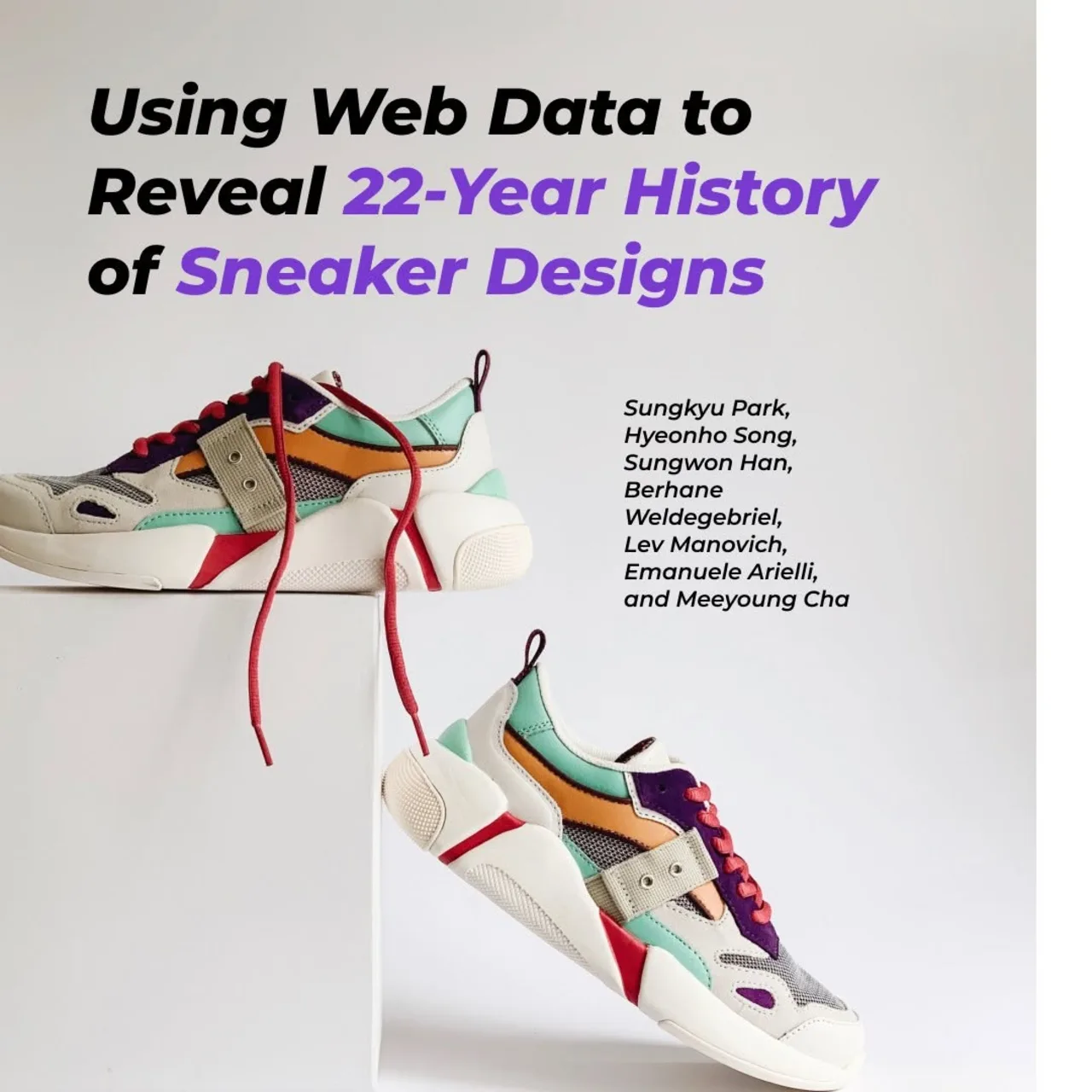
Sneakers have grown in popularity over the past two decades, and every brand has a look, from Jordan and Nike to Vans and Converse. Sungkyu Park, Hyeonho Song, Sungwon Han, Berhane Weldegebriel, Lev Manovich, Emanuele Arielli, and Meeyoung Cha used computational methods to track how those looks have changed. Their 2022 paper proposes a sneaker design index, a single number that follows the color and shape characteristics of sneaker designs over time.
Approach
The data was sneaker images and metadata from StockX.com, a reselling marketplace, covering 23,492 sneakers released from 1999 to 2020. Two models produced the design embeddings. A pretrained ResNet18 learned the visual features of the shoes, their colors and shapes. Unsupervised contrastive learning then refined that representation. The contrastive model applies multiple augmentations and masking, so small variations in image style during classification do not distort the result, and it produces disentangled projection heads that separate visual attributes such as shape from color.
That gave three embeddings per sneaker: color, shape, and combined. Principal component analysis on those embeddings produced the design index for seven brands known for distinct styles. The authors also computed the average pairwise cosine similarity between the top 12 brands using the color and shape embeddings.
Findings
By the design index, the color embeddings of sneakers from Air Jordan, Nike, Adidas, Reebok, Vans, New Balance, and Converse have converged in recent years. The average pairwise cosine similarity between brands via color embedding sits around 0.620, which means brands are becoming more alike in color. HSV trends from 2015 to 2021 show sneakers becoming more pastel-toned.
Shape tells a different story. The average pairwise similarity of brands via shape embedding is lower, between 0.390 and 0.425, so brands remain distinct from one another in silhouette.
What it suggests
The same method could be applied to hats, bags, or any other product with a long visual record, which opens the door to fashion trend prediction. Data science and machine learning can capture design trends in a form that designers can use as input to their own process.
Source: Park, S., Song, H., Han, S., Weldegebriel, B., Manovich, L., Arielli, E., and Cha, M. (2022). Using Web Data to Reveal 22-Year History of Sneaker Designs. Proceedings of the ACM Web Conference 2022. doi:10.1145/3485447.3512017