
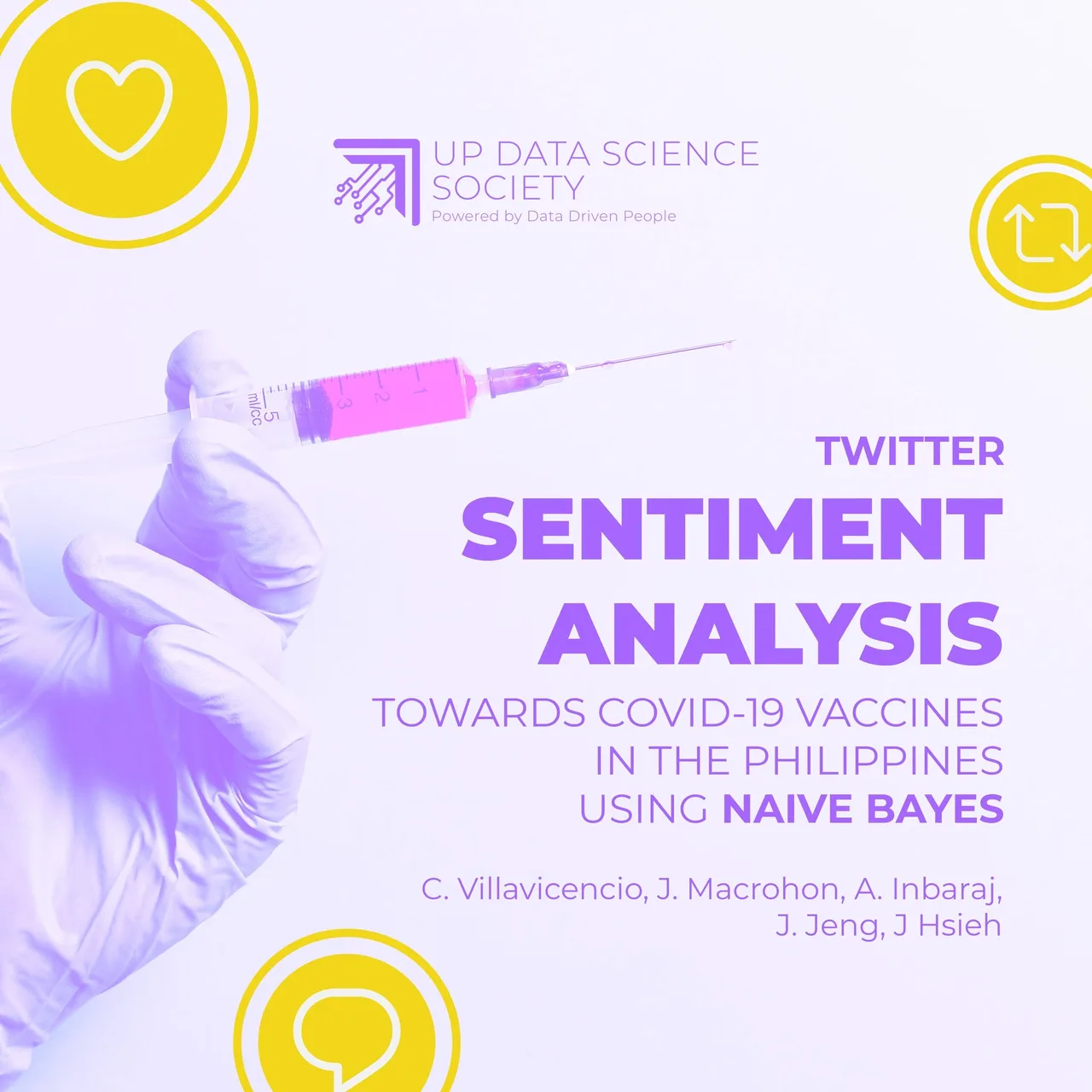
Resbakuna: how Filipinos on Twitter felt about COVID-19 vaccines
- Article
- Natural Language Processing
The Philippines began vaccinating against COVID-19 on March 1, 2021 under the Philippine National Deployment and Vaccination Plan for COVID-19 Vaccines, better known by its campaign name, ResBakuna. Vaccination was encouraged but not compulsory, which made public attitude a real variable in how the rollout would go. A study by Charlyn Villavicencio, Julio Jerison Macrohon, Alphonse Inbaraj, Jyh-Horng Jeng, and Jer-Guang Hsieh, published in the journal Information in May 2021, measured that attitude using tweets from the programme’s first month.
Method
The researchers collected tweets about COVID-19 vaccines in the Philippines, then cleaned the set by removing retweets and duplicates. Each remaining tweet was annotated as positive, neutral, or negative in polarity. Those labelled tweets became training data for a sentiment classifier built with the Naive Bayes algorithm, a standard method for text classification that works from the frequency of words in each class. The model’s performance was evaluated with k-fold cross validation, so that every tweet served as test data at some point rather than the score depending on one particular split.
Findings
A total of 11,974 tweets were collected with the RM (RapidMiner) Search Twitter operator. After preparation and preprocessing, 993 remained. Of those, 828 (83.38 percent) were positive toward the vaccines, 82 (8.26 percent) were negative, and 83 (8.36 percent) were neutral. The Naive Bayes model trained on this data reached 81.77 percent accuracy.
The paper’s word clouds give a sense of what each group was saying. Positive tweets are dominated by campaign words: Resbakuna, Bidabakunation, Bidasolusyon, vaccine, dose, thank. Neutral tweets are heavy on logistics and brand names such as Sinovac and Vaccineph. In the negative cloud, “hindi” and “kasi” stand out alongside “Covid” and “AstraZeneca”.
What it is for
The authors argue that sentiment analysis of this kind can inform government decisions on fund allocation, vaccine provision, and the scheduling of the rollout, and that positive public perception is itself part of winning against the pandemic. Two caveats are worth keeping in mind when reading the numbers. Twitter users are not a representative sample of Filipinos, and the cleaned dataset is under a thousand tweets. Even so, the study is a clear example of a full pipeline, from collection to a trained model, applied to a Philippine public health question in near real time.