
PlastiCount Pilipinas, an open database of marine plastics
- Article
- Open Data
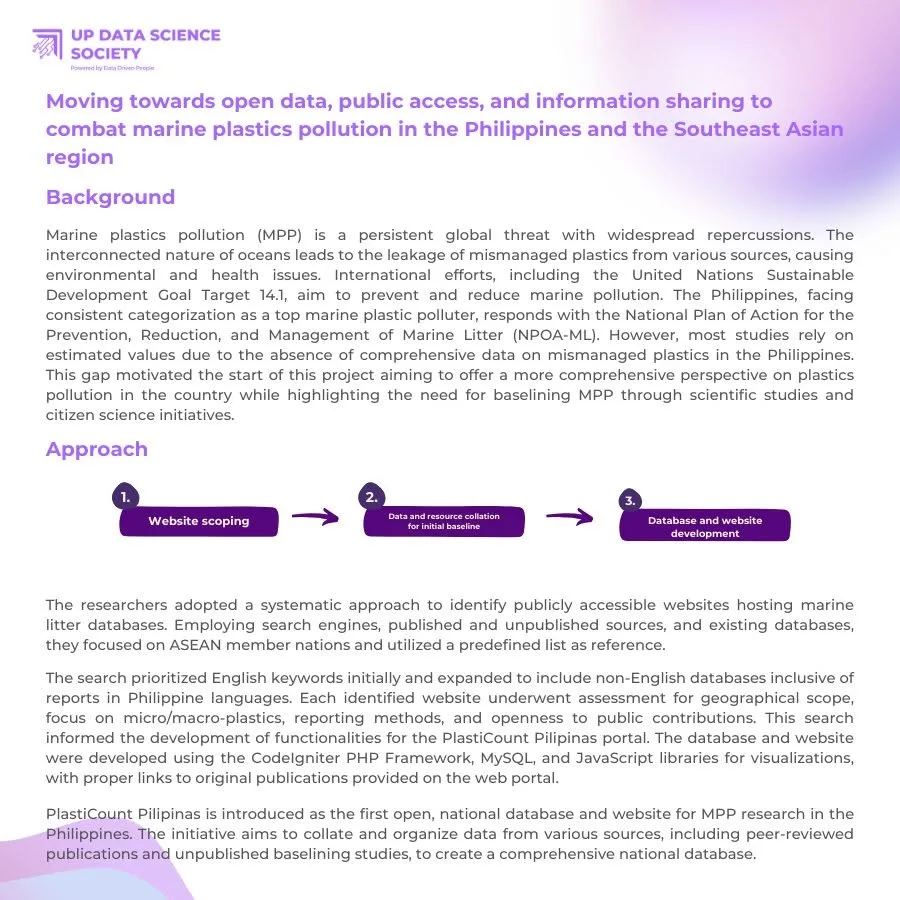
Plastic that leaks into the sea does not stay where it entered, so marine plastic pollution is treated as a shared problem under Sustainable Development Goal target 14.1. The Philippines is regularly listed among the top sources, and the government answered with a National Plan of Action for the Prevention, Reduction, and Management of Marine Litter. The problem is that most of the rankings rest on estimates, because there was no comprehensive record of how much mismanaged plastic the country actually has. PlastiCount Pilipinas was built to close that gap.
This post, published by UP Data Science Society on January 16, 2024 with content by Mary Joy Gutierrez and layout by Laviele Trias, summarizes a 2023 paper by R. Alindayu, L. O. Licnachan, R. Luzadas, P. S. Ignacio, and D. F. Onda in Ocean & Coastal Management.
Method
The team worked in three steps: scope existing websites, collate data and resources for a baseline, then build the database and portal. They searched for publicly accessible marine litter databases across ASEAN member states, starting with English keywords and then adding databases in Philippine languages. Each site was assessed for geographic scope, whether it covered micro- or macroplastics, how it reported results, and whether the public could contribute. What they learned shaped the portal, which was built with the CodeIgniter PHP framework, MySQL, and JavaScript charting libraries, with each record linked back to its original publication.
Findings
Regional databases in Europe, East Asia and the Pacific, and the Mediterranean are backed by regional agreements. For the Philippines and Southeast Asia, the ASEAN Regional Action Plan is the only signed agreement on marine plastics. Pulling data from secondary sources ran into six recurring problems: inconsistent reporting formats, incomplete metadata, results averaged across sampling stations, mixed units, different methods for different research questions, and different category schemes for micro- and macroplastics.
As of September 13, 2022, the database held 14 published and unpublished sources covering 2012 to 2021, 128 sample stations in 11 provinces (Palawan had the most) across 11 habitat types. The macroplastics data covered 32,830.425 square meters, 34 categories, and 46,420 pieces. The microplastics data covered 437,214.25 kilograms of sampled material, classified by shape (9 categories), polymer type (13), color (13), and morphology (10). The portal met all ten of the criteria the authors evaluated it against, including interoperability, citizen science, SDG reporting, and fit with the UNEP digital ecosystem, and offers an interactive bubble map, pie charts, and downloadable data.
Why it matters
The authors position PlastiCount Pilipinas as a template for national data protocols that other Southeast Asian countries can adopt. A shared baseline lets researchers, policymakers, and the public argue from the same numbers. The portal is live at plasticount.ph, where records can be filtered by scope, category, and location.
Source: Alindayu, R., Licnachan, L. O., Luzadas, R., Ignacio, P. S., and Onda, D. F. (2023). Moving towards open data, public access, and information sharing to combat marine plastics pollution in the Philippines and the Southeast Asian region. Ocean & Coastal Management, 243, 106771. doi:10.1016/j.ocecoaman.2023.106771