
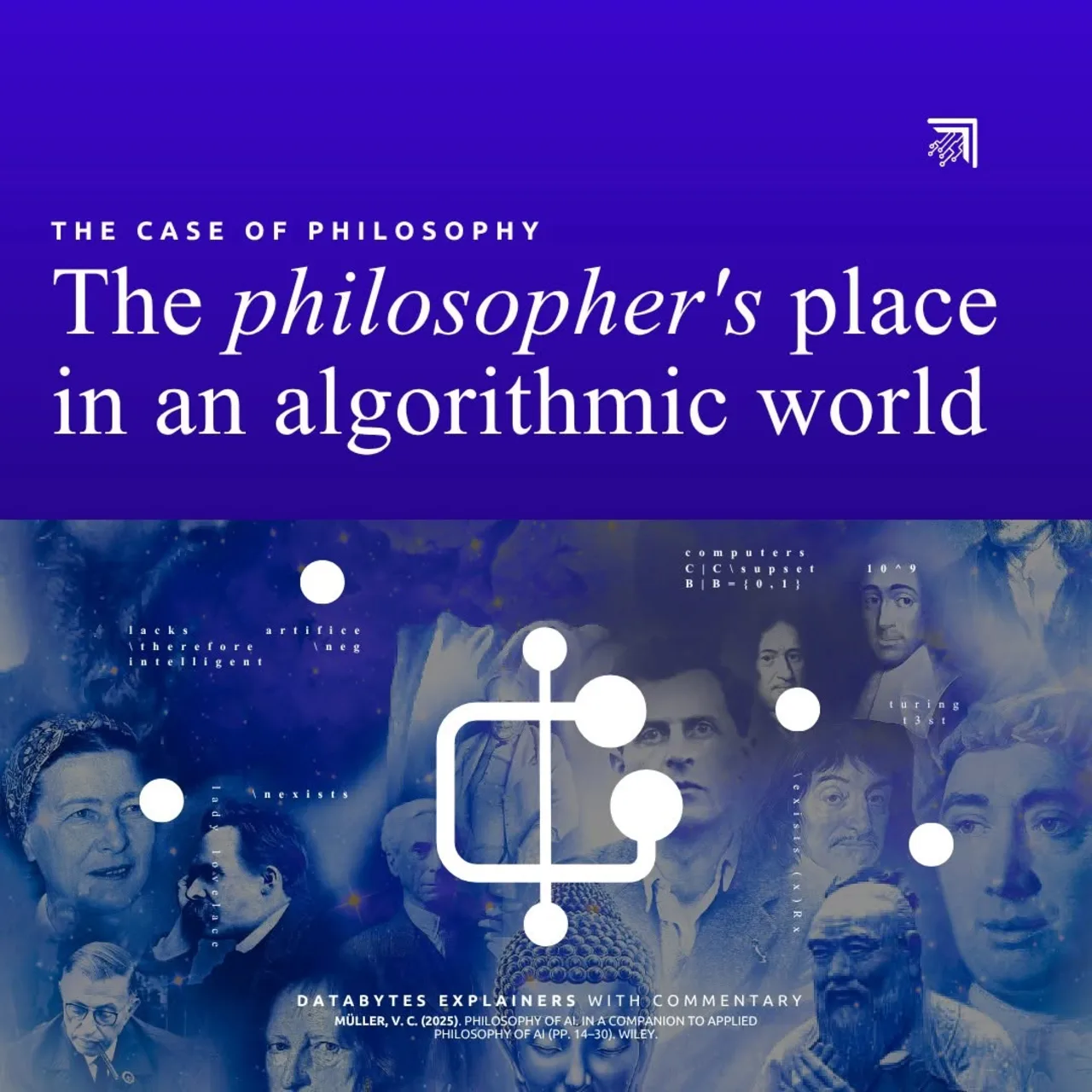
Why do models need constitutions? Can a model interpret what it outputs? Is what an AI does “thinking” in any biological sense? These questions sound abstract until you are the one building or evaluating a system. This piece, written by Artemio Arcega III for the society’s DataBytes series, is a commentary on Vincent C. Müller’s chapter “Philosophy of AI” in A Companion to Applied Philosophy of AI, edited by Martin Hähnel and Regina Müller and published by Wiley in 2025.
Three questions
Müller frames the field around three questions: what is artificial intelligence, what can AI do, and what should AI be. He is careful to say that these are only a way into the subject, not a full map of everything philosophers of AI study, interpret, and infer about.
The connection between philosophy and AI is not new. Alan Turing’s 1950 paper “Computing Machinery and Intelligence” opened with the question of whether machines can think, long before the transformer or the large language model existed. The two fields have been intertwined since the beginning.
Meaning, understanding, and the Chinese Room
In the section on meaning and representation, Müller takes up the Chinese Room argument. If a system manipulates symbols by syntax alone and produces the right outputs, does it understand anything? This is the old distinction between strong AI, a system that has understanding and other cognitive states, and weak AI, a system that only simulates them. The commentary points out that we cannot interpret a black box from its outputs and benchmarks alone. Doing so requires syntax, semantics, and the philosophy of language, of science, and of mind. Interpretability research, the effort to understand how models arrive at their outputs, already assumes an answer to whether these systems think.
Müller also extends the discussion past ethics into philosophy of mind, determinism, semantics, representation, and metaphysics. Computationalism, the view that thinking is a computational phenomenon, is one place where the assumptions can be put under pressure, and the answer bears directly on AI.
Why ethics has to be specific
“Is AI ethical?” is too vague to answer. In what way, where, at what stage, to whom, and to what? An answer can seem obvious, but it still has to be formalized, interpreted, and tested, both rationally and empirically. That is the reason interpretation, safety, and ethics are necessary conditions for developing these algorithms, not optional extras.
The commentary closes with a claim about institutions. At a time when new technologies threaten the stability of many jobs, universities have to stay places for free thinkers. The philosopher working alongside the data scientist and the machine learning engineer can evaluate intelligence, computation, perception and action, meaning, choice, free will, consciousness, and normativity. That is the critical thinker’s way of resisting handing over one’s autonomy and intellect to a tool that is supposed to serve people, not replace them.