
Predicting the side effects of radiation therapy before treatment starts
- Article
- Health
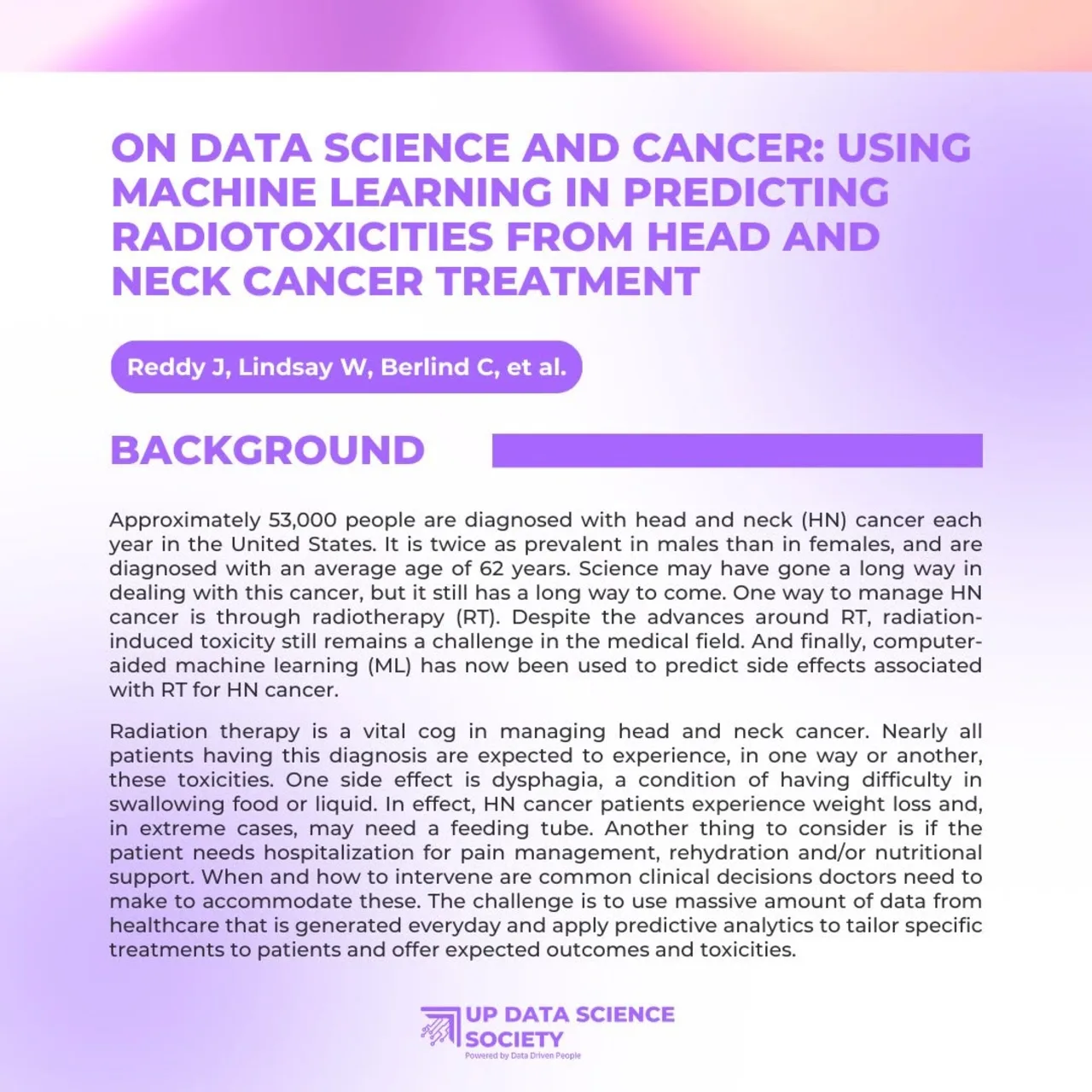
About 53,000 people are diagnosed with head and neck cancer each year in the United States. It is twice as common in men as in women, and the average age at diagnosis is 62. Radiation therapy is one of the main ways to manage it, and nearly every patient who gets it experiences some toxicity. Dysphagia, difficulty swallowing, leads to weight loss and in severe cases a feeding tube. Some patients need hospitalization for pain, rehydration, or nutrition. When and how to intervene are routine decisions for the treating doctor, and Jay P. Reddy, William D. Lindsay, Christopher G. Berlind, and colleagues at MD Anderson Cancer Center asked whether machine learning on the hospital’s own data could help make them earlier.
This post was written by Gideon Valdez with layout by Angelica Casuela.
Approach
The study aimed to predict three acute toxicities during radiation: unplanned hospitalization within three months of the start of treatment, significant weight loss of more than 10 percent of body weight, and feeding tube placement. It used 2,121 consecutive courses of radiation treatment for head and neck cancer from May 2016 to August 2018, with more than 700 clinical and treatment variables per course covering demographics, clinical and pathological characteristics, and radiation details.
Ninety percent of the courses, 1,896, went into a training set, and 225 were held back for validation. Three models were tried: a random forest of 100 trees, extreme gradient boosted decision trees with 100 trees, and logistic regression with L1 regularization. The best model for each endpoint was then checked on the validation set. The study set an area under the curve (AUC) above 0.7 as the threshold for clinical validity.
Findings
On the training set the three models performed similarly. Random forest was best for unplanned hospitalization (AUC 0.676) and gradient boosted trees were best for weight loss (0.843) and feeding tube placement (0.787). On the validation set, only the gradient boosted models for weight loss (0.751) and feeding tube placement (0.755) cleared the 0.7 bar. Hospitalization stayed below it at 0.640. The authors reported that the models were consistently good at predicting the two outcomes they were built for, and that a clinician could rerun them on a new patient and get a number for how likely the side effect is.
How it would be used
A patient arrives, is diagnosed, and is staged. Radiation therapy is chosen. Their age, body mass index, stage, biomarkers, risk factors, vitals, and treatment plan go into the model, which returns personalized probabilities for each toxicity. Those numbers inform whether to place a feeding tube up front, how aggressive nutritional support should be, or whether close monitoring is enough. As Reddy put it, a model that says eighty percent of patients with this profile get through treatment without a feeding tube is not perfect, but it is better than no understanding at all.
Source: Reddy, J. P., Lindsay, W. D., Berlind, C. G., et al. (2019). Applying a Machine Learning Approach to Predict Acute Radiation Toxicities for Head and Neck Cancer Patients. International Journal of Radiation Oncology, Biology, Physics, 105(1), S69. doi:10.1016/j.ijrobp.2019.06.520. See also the MD Anderson summary.