
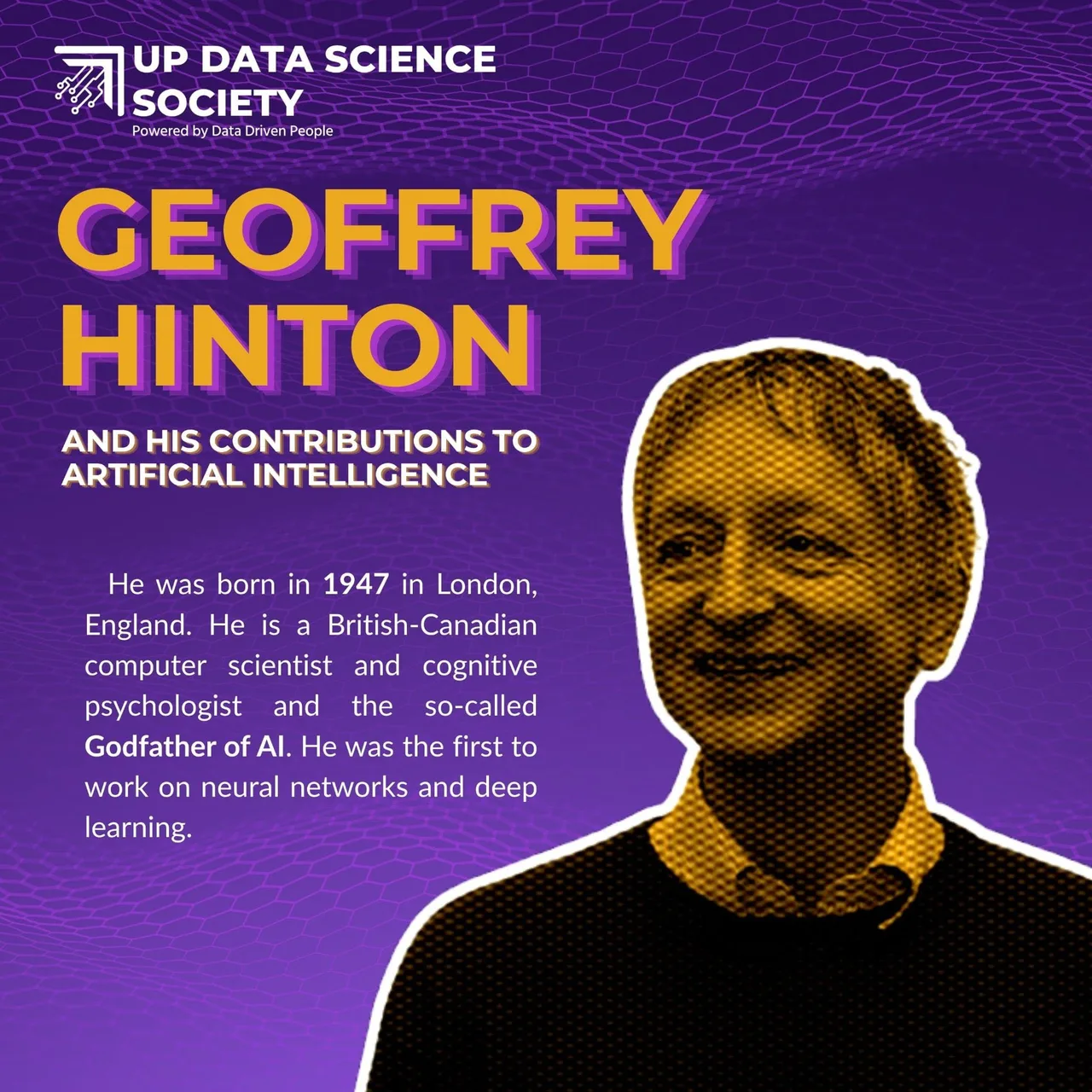
Geoffrey Hinton, the pioneer who now warns about his own field
- Article
- History
Every time someone asks a chatbot to explain something like they are five, or to rewrite a paragraph so it sounds less like a machine, they are using a technology that traces back to one line of research. This post is an explainer on the person most associated with it.
Who he is
Geoffrey Hinton was born in 1947 in London. He is a British-Canadian computer scientist and cognitive psychologist, and he is often called the “Godfather of AI” for his early and sustained work on neural networks and deep learning.
His central idea is that intelligence comes from large networks of simple units learning distributed representations, rather than from hand-written rules and symbols. In his view, a machine should learn the way people learn, from examples and from its own mistakes.
What he contributed
A neural network is a program loosely modeled on the networks of neurons in a brain. Hinton is one of the key people behind backpropagation, the procedure that lets a network adjust its internal weights based on how wrong its output was. If the network is the body, backpropagation is the nervous system that carries the error signal back through it.
In 2006 he introduced deep belief networks, which showed that networks with many layers could be trained in practice. That result revived interest in deep learning after years in which the field had been largely set aside, and it led to the systems behind today’s large language models.
Why he now sounds the alarm
After leaving Google in 2023, Hinton became one of the most prominent critics of the technology he helped build. He has said that it makes him sad to have spent his life on something he now considers dangerous, and that people are not taking the risks seriously enough. He has warned about the speed of progress, the lack of international regulation, misinformation, job displacement, and the long-term possibility of systems that are more capable than the people who are supposed to control them. One of his lines, quoted in the original post: “If we create [AI systems] so they don’t care about us, they will probably wipe us out.”
A pioneer of the field, and now one of its loudest voices for caution.
Source: this post is an explainer. It draws on Britannica’s biography of Geoffrey Hinton, Britannica’s entry on neural networks, BBC News on the 2019 Turing Award, MIT Technology Review’s 2023 interview, and a Times of India report on his warnings.