
Is it the driver or the car? A Bayesian look at Formula One
- Article
- Statistics
Formula One results depend on the skill of the driver and on the quality of the car the constructor builds. Because the two are always combined, it is hard to say from a finishing order alone who the best driver is. A 2022 paper by Erik-Jan van Kesteren and Tom Bergkamp tries to separate the two with a Bayesian multilevel Beta regression model.
Approach
The model treats each finishing position as a proportion (a Beta-distributed outcome) and explains it through four effects added together on the logit scale: a driver effect, a driver-by-season effect, a constructor effect, and a constructor-by-season effect. Each is given a normal prior centered on zero with its own variance, so the model can learn how much variation belongs to drivers and how much to constructors. The data covers the hybrid era, 2014 to 2021.
The authors also fit variants that add circuit effects, weather effects, or both, and compared them with leave-one-out cross-validation using the expected log posterior density (ELPD), a measure of predictive accuracy where higher is better.
Findings
The basic model performed best on ELPD, although the differences between the four models were small. The basic model was therefore used for the analysis, and it fit the observed data well.
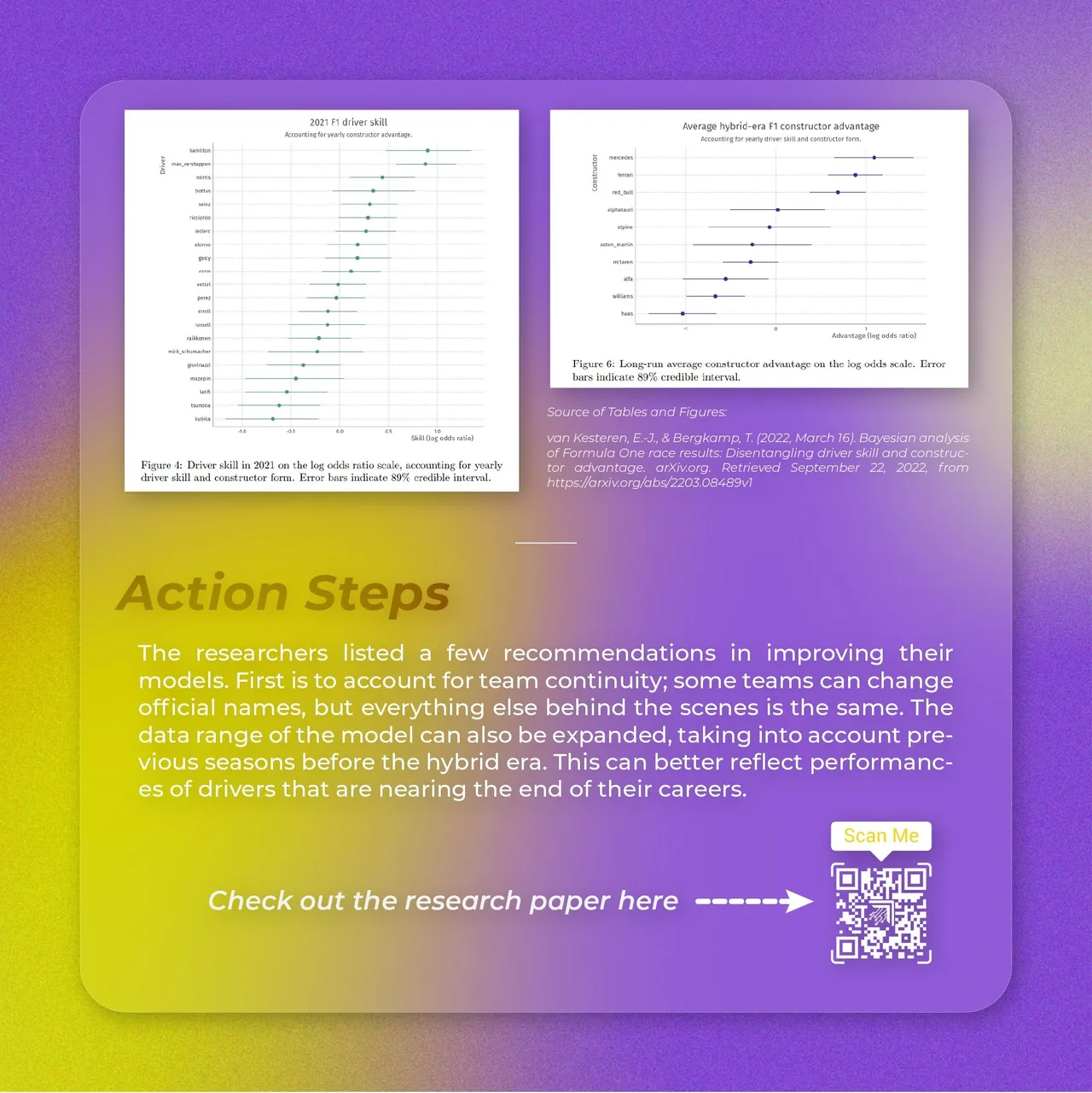
Among the 2021 drivers, Hamilton and Verstappen come out as the most skilled. Because the model only sees 2014 to 2021, it does not credit earlier world champions such as Vettel and Räikkönen for results outside that window. On the constructor side, Mercedes, Ferrari, and Red Bull are the three best teams of the hybrid era. The authors’ central conclusion is that the constructor has a larger impact on race results than the driver’s skill.
Source: van Kesteren, E.-J., and Bergkamp, T. (2022). Bayesian analysis of Formula One race results: Disentangling driver skill and constructor advantage. arXiv:2203.08489