
Finance, schooling, and institutions in the ecological footprint of emerging economies
- Article
- Environment
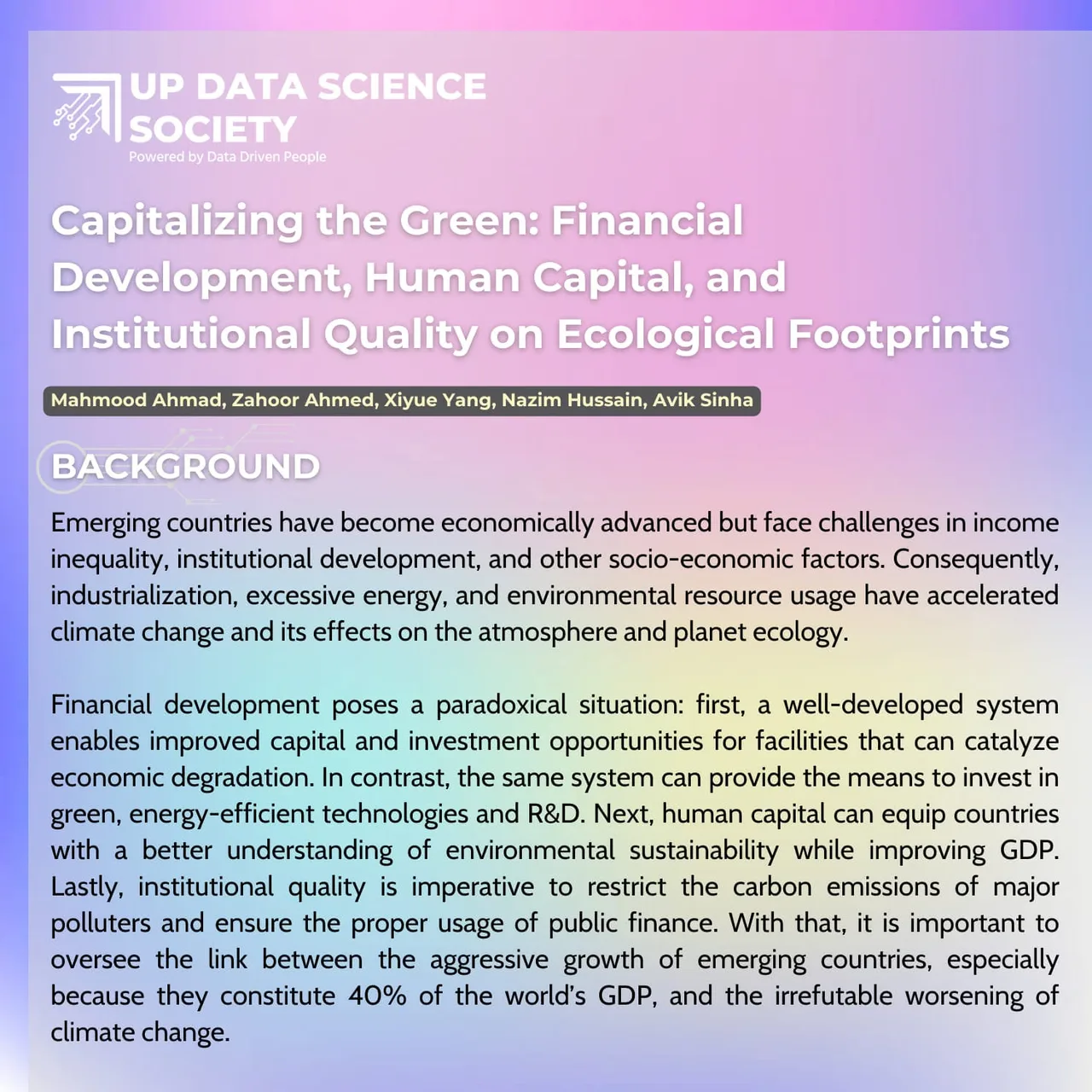
Emerging economies now produce around 40 percent of the world’s output, and their growth has come with more energy use, more industry, and a larger draw on natural resources. The ecological footprint measures that draw: how much productive land and water a population needs to supply what it consumes and absorb what it discards. A 2022 paper by Mahmood Ahmad, Zahoor Ahmed, Xiyue Yang, Nazim Hussain, and Avik Sinha in Gondwana Research asks what drives the footprint in these countries, and in particular what role finance plays.
The puzzle
Financial development cuts both ways. A deep banking system and open capital markets make it cheaper to borrow, which funds factories, vehicles, and construction that push the footprint up. The same system can fund efficient technology and research that pull it down. Which effect wins is an empirical question, and the authors argue it depends on two other things: human capital, meaning the education and skills of the workforce, and institutional quality, meaning how well governments enforce rules and use public money.
The method
The study uses panel data for a group of emerging countries over several decades. Because these economies trade with and influence each other, ordinary panel regressions that assume each country is independent can give misleading results. The authors instead use the cross-sectionally augmented autoregressive distributed lag estimator (CS-ARDL), which allows for that shared dependence and separates short-run from long-run effects. They also test an interaction term between financial development and each of the two moderating variables to see whether one changes the effect of the other.
The findings
Three results stand out. First, financial development on its own increases the ecological footprint. More credit means more consumption and production, and the environmental cost follows. Second, human capital and institutional quality each reduce the footprint. A better-educated population and better-run institutions are associated with a lighter environmental load. Third, and most useful for policy, the two moderators change the effect of finance. Where human capital is high, financial development works through it to improve environmental outcomes rather than degrade them. Where institutions are strong, the harmful effect of finance on the footprint is smaller.
What it means
The authors’ recommendation follows directly: emerging countries should not slow financial development to protect the environment, but should pair it with investment in education and with institutional reform, since those are what determine whether the new capital ends up in clean or dirty uses. The result also cautions against reading any single variable in isolation. Finance, skills, and governance act together, and a policy that moves one without the others may not get the outcome it expects.