
A library that knows which books you will like
- Article
- Libraries
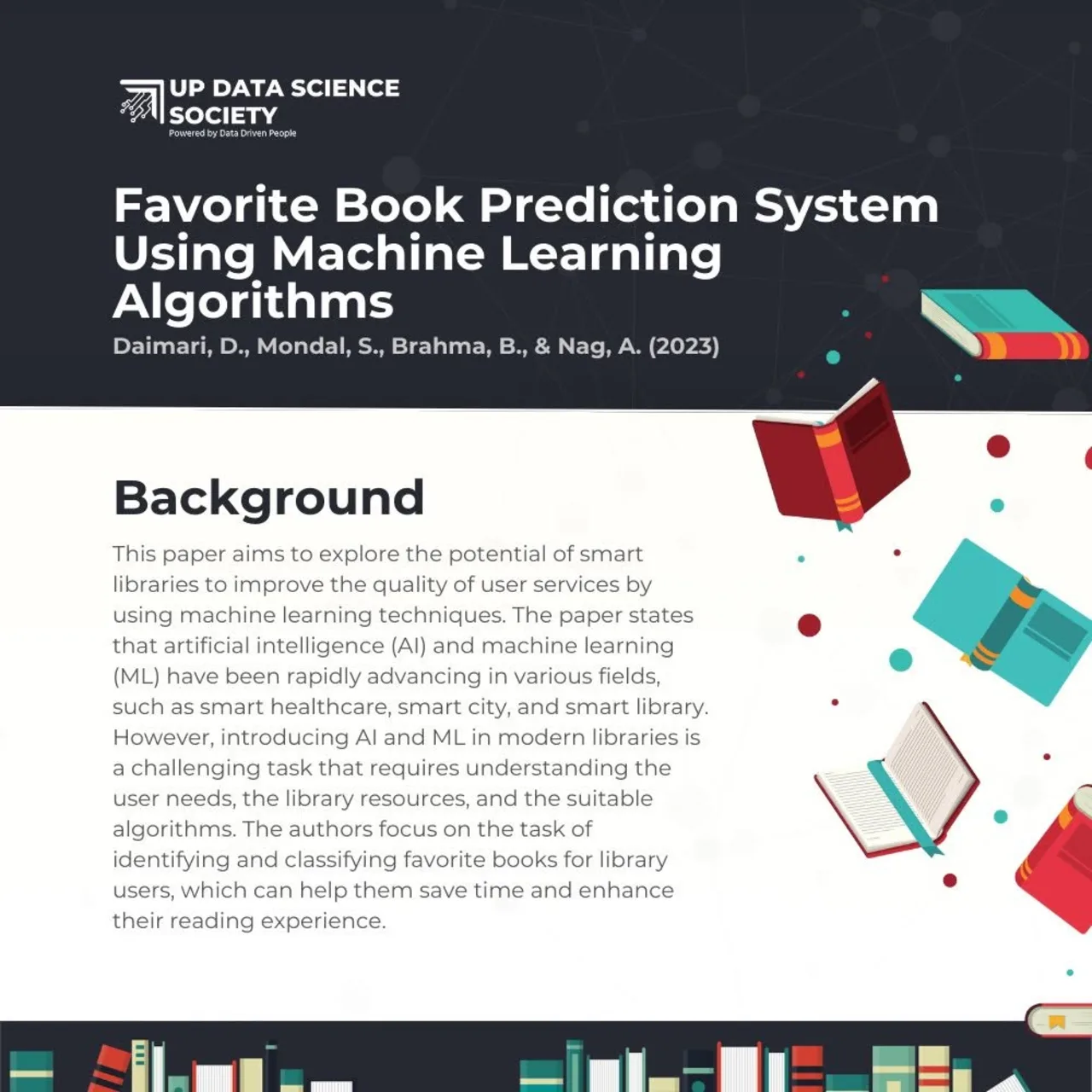
A smart library is one that uses data about its collection and its readers to serve them better. One concrete task in that direction is predicting which books a given reader will count as favorites, so the library can surface them without the reader having to search. A 2023 paper by Daimari, Mondal, Brahma, and Nag in the Journal of Applied Engineering and Technological Science takes on exactly this problem and treats it as a machine learning classification task.
The data
The authors used a public dataset on Kaggle built from the reading list of the musician Art Garfunkel, who has kept a record of every book he has read since 1968. Each entry carries details such as the author, the year, and the number of pages, and some entries are marked as favorites. The question for the model is: given the details of a book, will it be a favorite or not?
The method
The paper compares Random Forest with six boosting algorithms: Light Gradient Boosting Machine (LGBM), Histogram-based Gradient Boosting, Extreme Gradient Boosting (XGBoost), CatBoost, AdaBoost, and Gradient Boosting. All of these build many small decision trees. Random Forest trains the trees independently on random samples and lets them vote. Boosting trains them one after another, with each new tree focusing on the records the previous ones got wrong. The models were trained on part of the dataset and tested on the rest, and their accuracy on the held-out part was compared.
The result
LGBM came out on top with an accuracy of about 94.9 percent, ahead of Random Forest and the other boosting methods. The authors present this as the first intelligent application built specifically to identify and classify favorite books for a modern library, and suggest the same approach could help a library understand what its users need and shorten the time they spend looking.
A note on scope
The dataset comes from one reader, so the model learns one person’s taste rather than a general rule about books. Applying it in a real library would mean training on many readers’ histories, which raises questions about data collection and privacy that the paper does not cover. As a demonstration of the method, though, it shows how a small tabular dataset and off-the-shelf gradient boosting can get a useful classifier with little tuning.