
Flagging at-risk students with data the registrar already has
- Article
- Mental Health
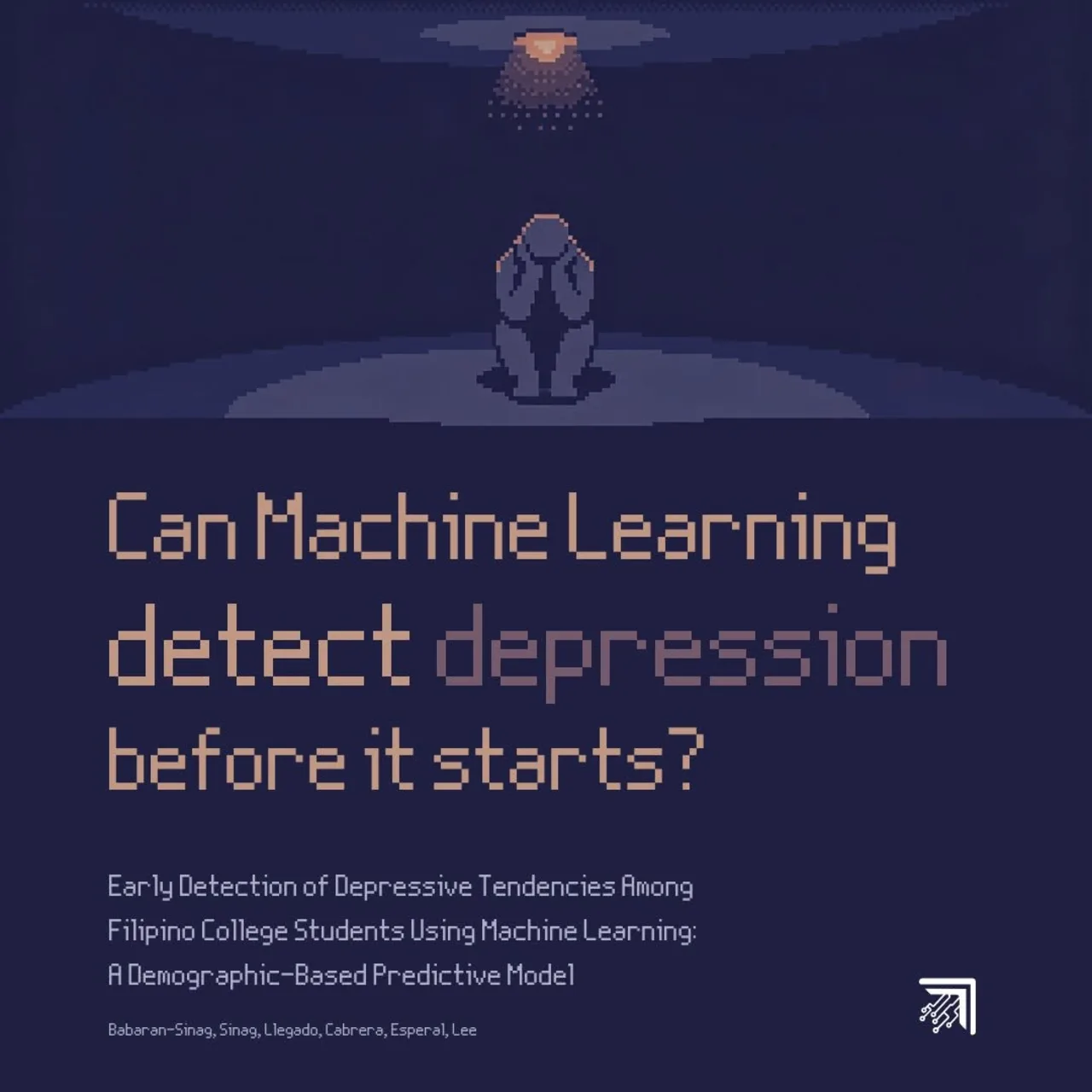
Depression is a leading cause of disability among students. In the Philippines, stigma and the shortage of mental health services mean many students only get help after they have reached a breaking point. A 2025 paper presented at the IEEE International Conference on Computing (ICOCO) asks whether schools could spot who needs support earlier, using information they already collect at enrollment.
The study is by Janel Reis Babaran-Sinag, John Rover Sinag, Fides Joyce Llegado, Gino Cabrera, Marissa Esperal, and Mari Jane Lee of Southern Luzon State University.
The data
The team collected non-clinical data from 1,585 students across 38 higher education institutions in Quezon Province. Instead of medical history or clinical interviews, the model uses seven routine factors: age, sex, academic program, year level, socioeconomic status, family type, and living arrangement. The framing draws on the diathesis-stress model, in which a predisposition combines with environmental stress to produce symptoms.
The models
Six supervised models were compared: logistic regression, random forest, gradient boosting, LightGBM, an artificial neural network, and discriminant analysis. LightGBM did best, with 94 percent accuracy and an AUC of 0.97 in distinguishing students with and without depressive tendencies. Random forest and gradient boosting were close behind at around 92 percent, which the authors take as a sign that ensemble methods suit this kind of social science data.
To see what drove the predictions, the team used SHAP (SHapley Additive exPlanations). Three factors stood out. Students living away from their families were at significantly higher risk. Coming from a non-nuclear household was a key predictor. And certain academic programs showed higher correlations with depressive tendencies than others.
What it could mean for schools
The authors sketch how a university might use this. A model like theirs could run on enrollment records already on file and feed an institutional dashboard that flags students for early outreach. Because it does not need clinical data, the screening is less likely to carry stigma, and it scales to a whole student body. They stress that any deployment has to comply with the Data Privacy Act of 2012 (Republic Act 10173), with anonymization and student consent built in.
The usual caution applies to a 94 percent figure: it was measured on one province’s data, and a flag from a demographic model is a prompt to reach out, not a diagnosis.