
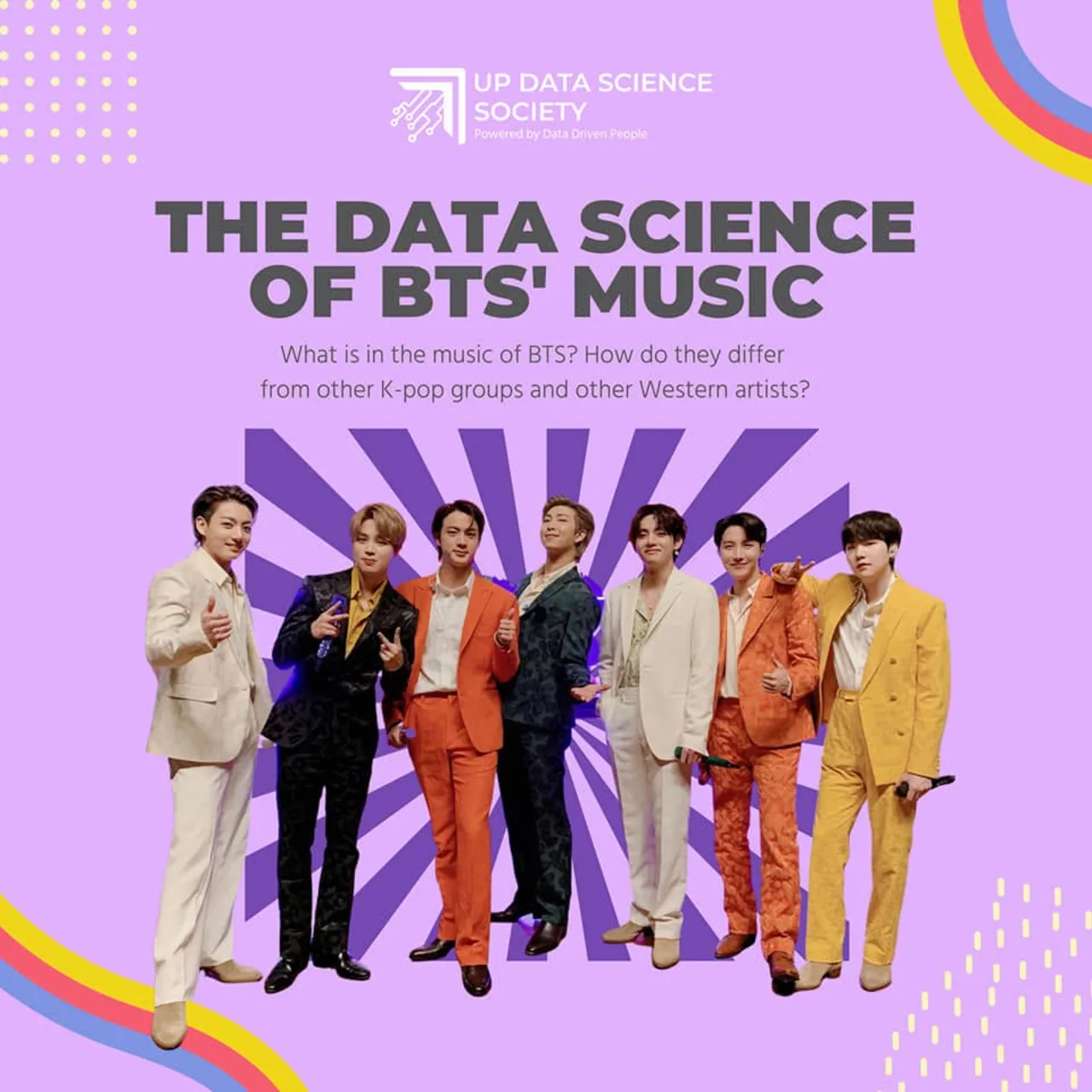
How did a Korean boy group become one of the biggest acts in the world? There are many answers to that, and most of them are about people, marketing, and timing. In a 2018 article on Towards Data Science, data scientist Haebichan Jung looked at a narrower one: the music itself. Using audio features and machine learning, he asked what is in BTS’ songs, how they differ from other K-pop groups, and how they compare with Western artists.
Tempo
The first thing the article looks at is tempo, measured in beats per minute for every track in each group’s catalogue. Jung plotted the tempo distributions of three K-pop groups: BTS, BigBang, and iKon.
The shapes are quite different. BigBang’s songs cluster tightly around a single tempo near 125 beats per minute, with a tall, narrow peak. iKon has a smaller cluster in a similar range. BTS’ distribution is flat and wide by comparison, with songs spread from below 75 to above 175 beats per minute and no single dominant tempo.
Jung’s reading of that chart, quoted in the post, is that “BTS’ music is diverse in rhythm and speed, comprising of songs that are both extremely fast and slow in pace.” A listener moving through the group’s albums hears ballads, mid-tempo tracks, and fast dance songs, rather than variations on one speed.
Beyond tempo
The article goes further than tempo. Jung also compared the groups on other features available from streaming audio analysis, and looked at how BTS compares with Western artists. According to the article’s own summary, the traits that set BTS’ songs apart are their energy, a higher ratio of vocal parts relative to instrumental parts, and the range of tempos from song to song. The suggestion is that these properties line up with what mainstream audiences respond to, which may be part of why the group crossed over where other K-pop acts did not.
This was the first of a two-part series. The second part turned to lyrics and used natural language processing to look at what BTS sings about.
Why it matters
The point of the exercise is less about BTS than about what audio features can reveal. Every streamed song comes with numbers attached: tempo, energy, danceability, how much of the track is vocals. Lining those numbers up across artists turns a question of taste into one that can be measured, argued about, and checked. It is a small, concrete example of how data science can be applied to something as ordinary as a playlist.