
Predicting the heat that bleaches coral, two weeks ahead
- Article
- Environment
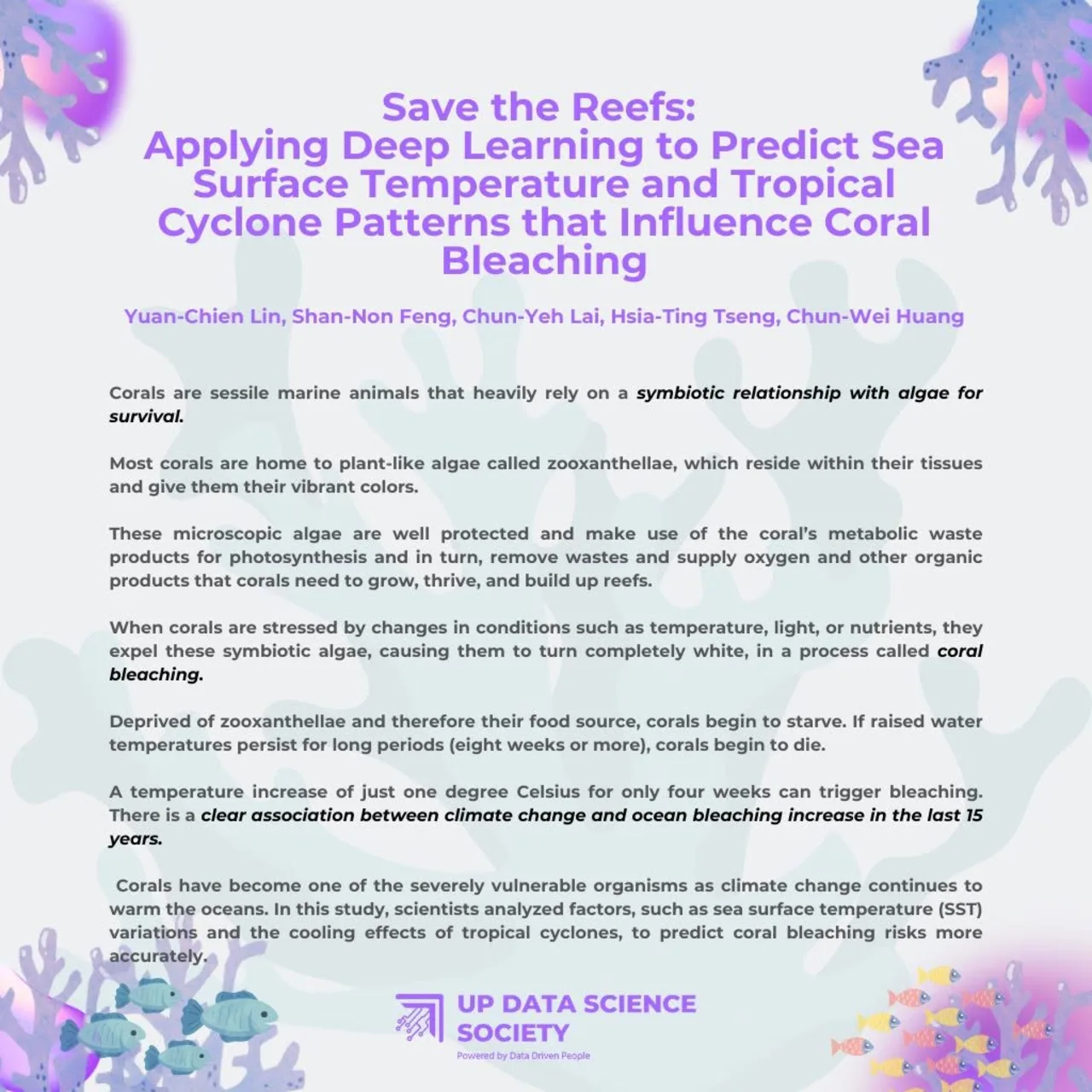
Corals are animals that depend on algae to live. Most host zooxanthellae inside their tissue, which return oxygen and organic compounds the coral needs to grow and build reefs. When water gets too warm, the coral expels the algae and turns white. That is coral bleaching. Without the algae the coral starves, and if the heat lasts eight weeks or more it dies. One degree Celsius of warming for four weeks is enough to trigger it.
Yuan-Chien Lin, Shan-Non Feng, Chun-Yeh Lai, Hsia-Ting Tseng, and Chun-Wei Huang of National Central University, Taiwan, built models to predict the two things that decide a reef’s fate in a given season: sea surface temperature (SST) and the cooling effect of tropical cyclones.
This post was written by John Marquel Revilla with layout by Reuben Gerome Tigao.
Approach
Two models were used. A Convolutional Long Short-Term Memory network (ConvLSTM), a deep learning model suited to autocorrelated sequences, was trained on historical SST observations to predict daily SST one day, one week, and two weeks ahead. A random forest was trained on four factors, the classification from empirical orthogonal function (EOF) analysis, a typhoon intensity classification, the distance between the typhoon center and the study area, and the typhoon track, to predict whether a typhoon pattern would produce a significant SST cooling effect.
The study area was South Penghu Marine National Park (SPMNP), west of Taiwan, within a 400 kilometer diameter. Thirty years of data (1991 to 2020) from the Japan Meteorological Agency and the Taiwan Central Weather Bureau’s typhoon database gave the SST, degree heating weeks (DHW), and cyclone trajectories.
Findings
The ConvLSTM reached 99.22, 99, and 98.4 percent accuracy at the 1, 7, and 14 day horizons and beat ARIMA, SVM, RNN, LSTM, and GRU on every error metric. The random forest predicting cooling effects reached 92.90 percent accuracy, with EOF classification and typhoon track the most reliable features.
SST and DHW both peaked in 2020, past the critical DHW thresholds and the coral threshold of 29.3 degrees Celsius, pointing to a rise in bleaching in southern Taiwan and its outlying islands. SST at SPMNP has risen 0.7308 degrees Celsius over 30 years. The study found that typhoon activity and its cooling effect reduce bleaching, which agrees with earlier work. No typhoon reached SPMNP directly in 2020, and if current trends hold, corals will find it harder to survive without typhoons stirring and cooling the water.
Why it matters here
The models give conservation bodies a way to know the risk ahead of time and plan early warnings. The study is about Taiwan, but the Philippines sits at the center of the world’s marine biodiversity, and the same approach is a starting point for assessing coral health in local waters.
Source: Lin, Y.-C., Feng, S.-N., Lai, C.-Y., Tseng, H.-T., and Huang, C.-W. (2023). Applying deep learning to predict SST variation and tropical cyclone patterns that influence coral bleaching. Ecological Informatics, 77, 102261. doi:10.1016/j.ecoinf.2023.102261