
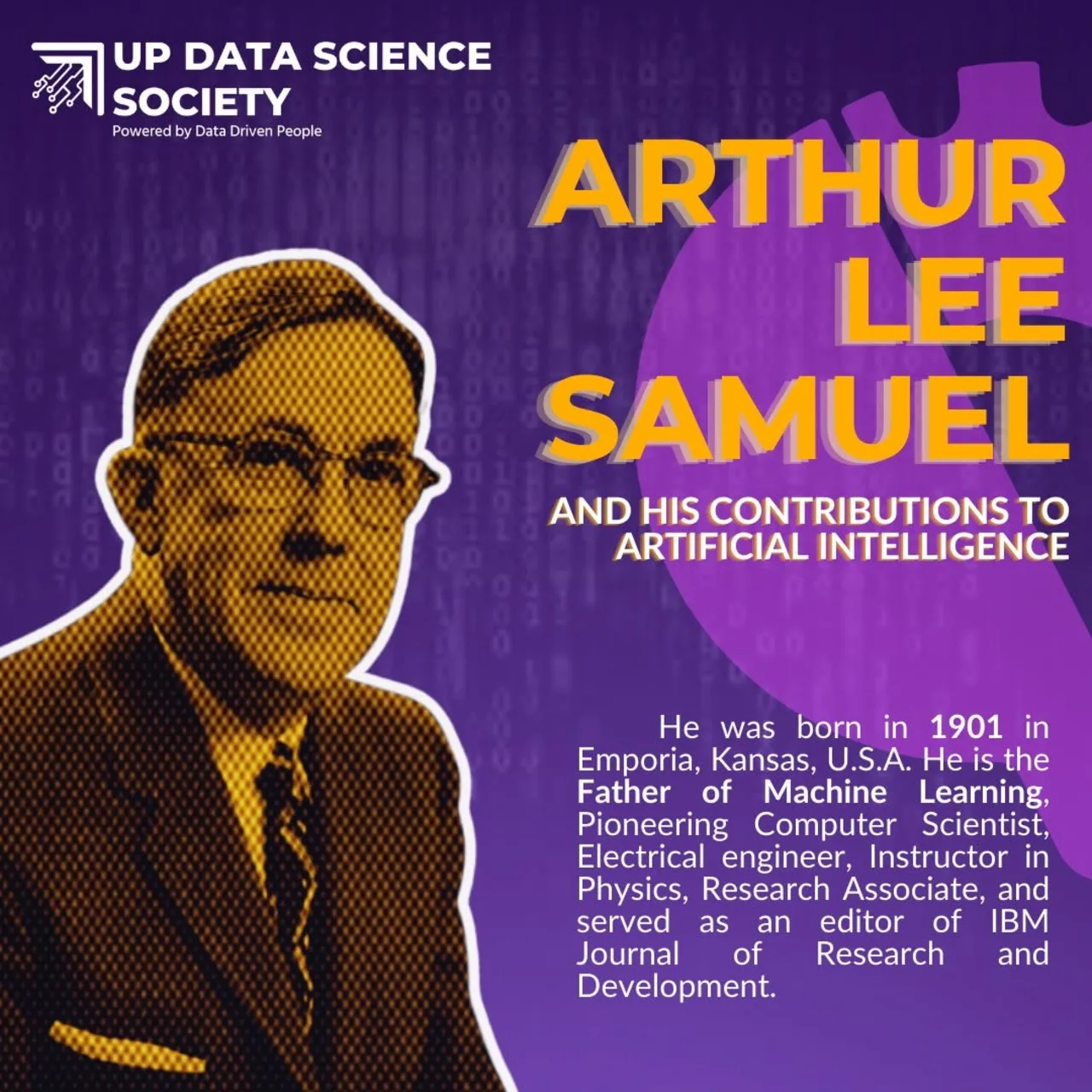
Arthur Lee Samuel, the father of machine learning
- Article
- History
Arthur Lee Samuel was born in Emporia, Kansas in 1901. He studied at the College of Emporia, then finished a master’s degree in electrical engineering at the Massachusetts Institute of Technology in 1926. He stayed at MIT as an instructor until 1928, then spent almost two decades at Bell Telephone Laboratories working on electron tubes and, during the war, on radar. In 1946 he moved to the University of Illinois as a professor of electrical engineering. It was there, while the university was trying to build its own computer, that he first thought about writing a program that could play checkers.
He joined IBM’s Poughkeepsie laboratory in 1949 and wrote the program on the IBM 701, the company’s first commercial computer. Checkers was a deliberate choice. The rules are simple enough to fit in the memory of a 1950s machine, but the game has far too many positions for a computer to search to the end. So the program had to judge positions instead of solving them.
How the program learned
Samuel’s program scored each board position with a formula that weighed features such as piece count, mobility, and control of the center. The key idea was that the weights were not fixed. The program played against copies of itself, compared the score it gave a position with the score it reached a few moves later, and adjusted the weights to reduce the gap. It also kept a table of positions it had already seen, a form of memorization he called rote learning. Over many games the program got better without anyone telling it how, and it eventually played better than Samuel himself. It went on to beat a Connecticut state champion.
He described the method in a 1959 paper in the IBM Journal of Research and Development, “Some Studies in Machine Learning Using the Game of Checkers.” The title put the phrase “machine learning” into print, and the paper is the usual starting point when textbooks trace the history of the field. Samuel later served as editor of the same journal and helped set up IBM’s research laboratories in Europe.
He retired from IBM in 1966 and moved to Stanford University, first as a lecturer and later as a research professor. He kept programming into his eighties, contributing to the operating system of the Stanford Artificial Intelligence Laboratory and to Donald Knuth’s TeX typesetting project. He died on July 29, 1990.
Samuel’s checkers work is the first well-documented example of a program improving its own performance from experience, which is why he is usually called the father of machine learning. The ideas in it, evaluation functions tuned by self-play and lookup tables of known positions, are direct ancestors of the game-playing systems built decades later.
Source: Professor Arthur Samuel, Stanford Computer Science memorial page