
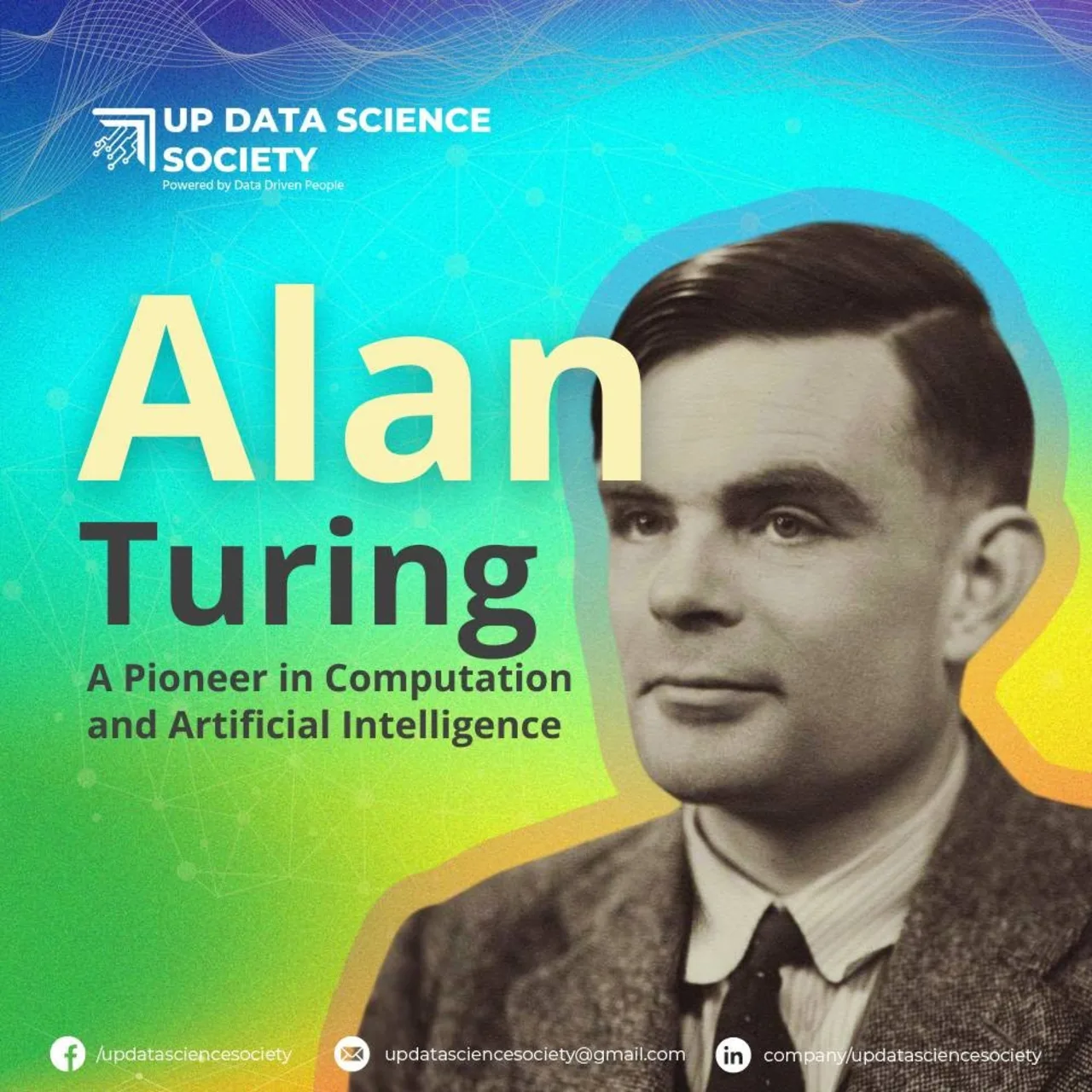
Alan Turing, a pioneer in computation and artificial intelligence
- Article
- History
To close Pride Month in June 2024, the UP Data Science Society published a short explainer on Alan Turing, the British mathematician and logician whose work sits under much of computer science, artificial intelligence, and, by extension, data science.
Early life and mathematics
Turing went to the University of Cambridge in 1931 to study mathematics. He was later elected to a fellowship at King’s College for his research in probability theory. His contributions ran across computer science, mathematical biology, and artificial intelligence.
Theory of computation
In 1936, Turing set out to answer the Entscheidungsproblem, which asked whether an algorithm could decide the truth or falsity of any mathematical statement. To do it he imagined a machine with an infinite tape of symbols carrying its own instructions, now called the universal Turing machine. With it he proved that some problems cannot be solved by any step-by-step procedure. That construction formalized the ideas of computation and algorithm that every program, including every machine learning model, still relies on.
Cryptography
During the Second World War, Turing worked on breaking the Enigma cipher machine used by the German military, which had billions of possible settings. Building on earlier work by a Polish mathematician, he and his colleagues designed the Bombe, a machine that searched the possible settings mechanically.
The Turing test
In his 1950 paper “Computing Machinery and Intelligence,” Turing asked whether machines can think and proposed a practical test. A human judge converses with both a human and a machine without knowing which is which. If the judge cannot tell them apart, the machine passes. The idea remains a reference point in debates about artificial intelligence.
His life and death
In 1952 the British government convicted Turing of having sex with a man. He avoided prison by submitting to what is now called chemical castration. He died in 1954, at 41, of cyanide poisoning; the death was ruled a suicide at the time, though later analyses have suggested it may have been accidental. More than fifty years passed before the British government apologized and pardoned him, after sustained advocacy from the scientific community. The Turing Award, the highest honor in computer science, carries his name.
Turing lived openly at a time when that was a crime. The society’s post marked Pride Month by recognizing both his work and that fact.
Source: this post is an explainer. It draws on History of Data Science, “Alan Turing: Behind the World War II legend” (2021), NIST, “Alan Turing’s Everlasting Contributions to Computing, AI and Cryptography” (2022), Encyclopedia Britannica, “Alan Turing and the beginning of AI”, and Built In, “What is the Turing Test?” (2023).