
Huwag kuKURAP: probing public records with data science
- Workshop
- Public
· Time: – Hybrid
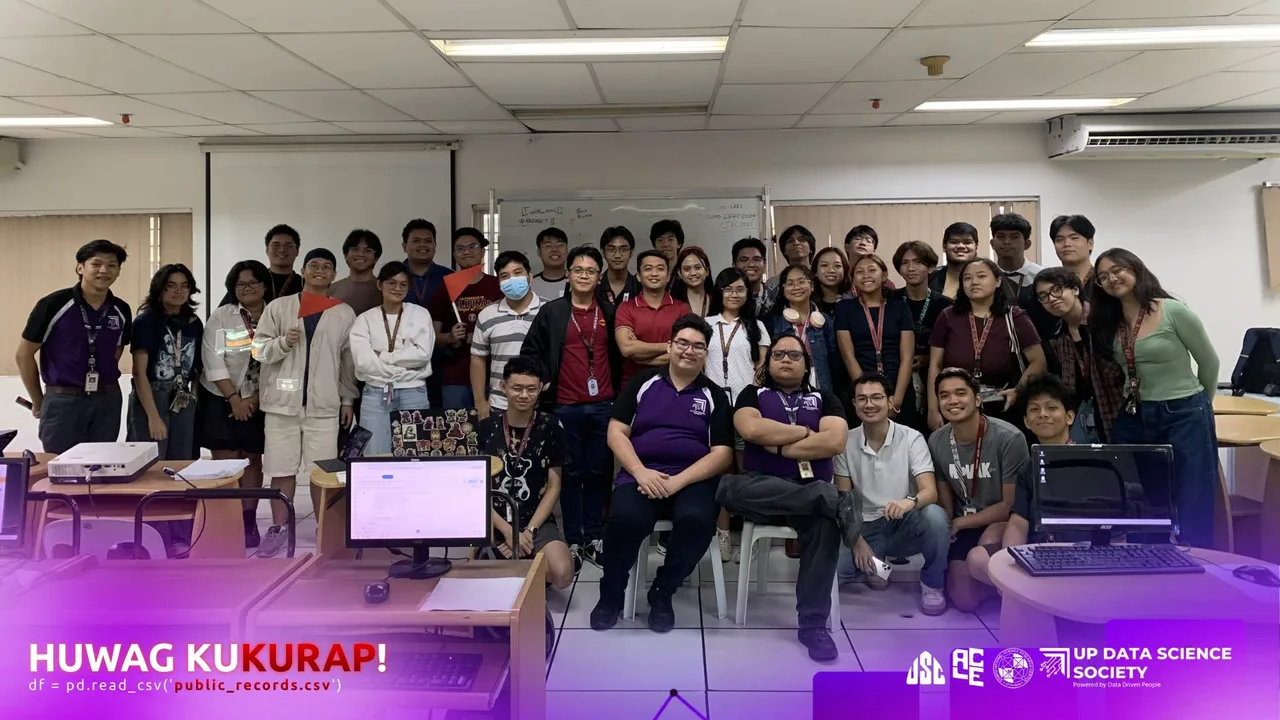
Read the announcement on Facebook“Huwag kuKURAP: Probing Public Records with Data Science” was the UP Data Science Society’s first workshop for the Alternative Classroom Learning Experience (ACLE), held on February 24, 2026, from 2:30 to 4:00 PM. It was billed as a crash course in investigative data analytics: skip the rhetoric, go to the source, and learn how to extract and analyze public records to find patterns that point to government corruption.
ACLE is a UP Diliman tradition. For one day each semester, regular classes give way to sessions proposed and run by student organizations, and students choose which ones to attend. The title is a play on words. “Huwag kukurap” means “don’t blink” in Filipino, and the capitalized KURAP echoes “corrupt.”
Speakers
Lanz Lagman is the Lead Data Scientist at the Global Coordination Center, where he drives internal research and the integration of generative AI into business operations. He was the Head Director of the UP Data Science Society at the time, holds an MSc in Physics, and is pursuing a PhD in Data Science at UP Diliman, with research on applying generative AI to data-driven studies of galactic morphology.
Charles Justin Shi is a Data Product Engineer at Insular Life Assurance Company, where he designs and delivers end-to-end data solutions. He graduated summa cum laude with a BS Mathematics degree from UP Diliman, is a Fellow of the UP Data Science Society, and is an AI Governance Scholar at AI Safety Diliman.
Venue and turnout
The workshop was hybrid. The in-person session was held at Lab 1, first floor of the Computational Science Research Center (CSRC) on P. Velasquez Street, UP Diliman, with slots limited to UP Diliman students. Everyone else joined over Zoom or watched the livestream on the society’s Facebook page. More than 200 people took part: over 180 online and 30 on site. Photos are by Artemio Arcega III, and the society thanked BetterGov.PH for its support.
Materials
On March 20, 2026 the society released the material used in the workshop as an open-source repository, UP-DSSoc/ACLE-2025 on GitHub, so that anyone, whether a data scientist or a curious citizen, can look for anomalies in public data on their own.